Introduction Journal 50 – 50th Edition

We have great pride in reaching the Golden Edition of Everyone’s War –  our 50th edition.

Over the last twenty-four years the journal has showcased many treasures from the Archive, and with the impending redevelopment of our website war-experience.org we hope to be able to share many more with you in the near future.

The 50th Edition presents a mixed collection of wartime experiences, beginning with Mosquito navigator Stan Hope. Due to engine trouble, he had to bail out over enemy territory and went on the run with the help of the clandestine escape network of the Comète Line until betrayal led him to be captured and interrogated by the Gestapo. After months of solitary confinement, he was released to a prison camp. In a tale of derring-do, Britain’s second highest scoring Hurricane ace Frank Carey tells of his action on the front line in Battle of France. Despite being shot down and wounded, he escaped and arrived home in time for the Battle of Britain, only to be shot down once more after being ‘bullet-stitched’ during a dogfight. Undeterred and undefeated, he went on to fly against
the Japanese in Burma, finishing the war with a second bar to his DFC.

Interviews

In an interview for the Archive by Dr Peter Liddle in 2002, Sir Stephen Hastings of the Scots Guards recollects his service with the SAS, in particular the Benghazi and Sidi Haneish raids, extolling the ‘phenomenal’ leadership of SAS founder Sir David Stirling. In another interview, we have Holocaust survivor Leon Greenman, interviewed by David Talbot. Despite having British nationality, Leon and his family were sent to Auschwitz. Only Leon survived. After liberation, he became an active educator and campaigner for Holocaust awareness.
Another remarkable story of survival against the odds is that of William Griffiths who was captured by the Japanese in Java and consequently suffered major life-changing injuries including the loss of his sight. In his interview, he openly reveals the effect this had
on him, the coping strategies he used, and of how he overcame adversity to build a successful life helping other disabled veterans.

Memoirs

Gunner Tom Evans who served in the Singapore Royal Artillery wrote his memoir on the troopship home after his liberation. He spent three-and-a-half years as a prisoner of the Japanese on the Thai-Burma Railway, during which he laboured on the notorious Hellfire Pass cutting. In Arakan was David Cookson who served with the Gambia Regiment. In an extract from his comprehensive memoir, Pagoda Hill tells of one of D Company’s most notable engagements, describing how the company with just fifty remaining men, three quarters of whom were unarmed, was outflanked and overrun.
Platoon runner Robert White served in the ill-fated D Company of 1st Battalion Glasgow Highlanders during the clearing of the Roer in 1945. In his memoir, he describes front line action in a constantly depleted infantry company in which he was one of the few original members to make it through to the end of the war.
Twice-torpedoed Merchant Navy gunner Austin Byrne miraculously survived the war. He took part in Arctic convoys, crossing one of the world’s most dangerous sea routes – the Arctic Circle to Russia. He was serving aboard SS Induna during convoy PQ-13 in 1942, bound for Murmansk, when his ship was sunk by U-376. His memoir tells how he survived four days in the Arctic, exposed to the elements in an open boat.
In Belgium is Captain Denis Dodd of the Royal Warwicks, serving with the BEF in 1940. He sustained gunshot wounds in both legs and was therefore categorised as one of the ‘Grand Blessé’ (critically injured). His memoir gives insight into the life ofa POW amputee and reflects upon the German treatment of enemy wounded.
One of the Archive’swartime nurses, Muriel Salter, tells in her memoir of how she nursed BEF soldiers evacuated from Dunkirk at Park Prewitt Hospital. Her article QAIMNS Nurse
continues with her overseas service.
Another of the women in the Archive is Madame Valentine Roulland. She lived in Bayeux, France, throughout the war. Her letters to a family member, written between June – August 1944, give a unique insight as to what life was like for civilians caught up in the midst of the Battle of Normandy.

Journal 50 – 50th Edition
To become a Friend and receive the Journal free, Join Us.

Have you Logged in?

CONTENTS – Everyone’s War – 50th Edition

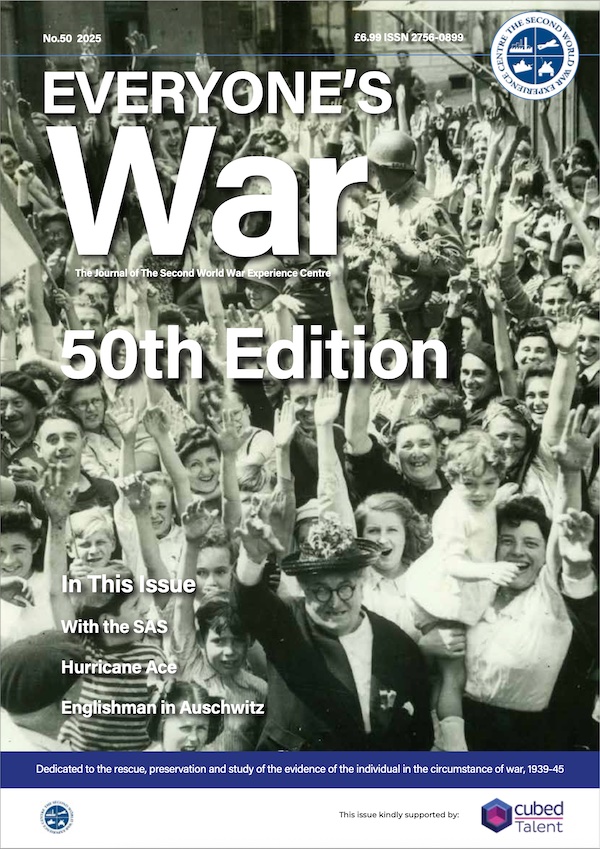
Journal 50th Edition Cover

Regular Features
  • Centre News
  • Book Reviews
  • Journals for sale
  • The Last Post
Special Features
  • Note from the Editor – Amanda Herbert-Davies
  • On the Loose – Stanley Hope
  • With the SAS – Sir Stephen Hastings
  • Grand Blessé – Denis Dodd
  • QAIMNS Nurse – Muriel Salter
  • SS Induna – Austin Byrne
  • Against the Odds – William Griffiths
  • Hurricane Ace– Frank Carey
  • Englishman in Auschwitz – Leon Greenman
  • Pagoda Hill – David Cookson
  • Letters from Bayeux – Valentine Roulland
  • Runner on the Roer – Robert White
  • Thai-Burma Railway– Thomas Evans


Cover image – Cheering crowds in Lamballe, France, welcome the arrival of liberating American forces. Lieutenant CharlesRhodes of Hollywood, California, is standing on his jeep holding a bunch of flowers. (Blow, R)

Digital Download –


Everyone’s War – 50 – 50th Edition – PRINTED version price – Please contact the Centre.

Stan Hope, Audio Excerpt

Excerpt From Audio Interview with Stan Hope, W/O RAF

Transcript of Audio Clip

The Mosquito exit was very small but fortunately I’m fairly small myself, so, I remember Mac. . . I sat on the . . . kicked the door open, sat with my legs hanging out, shook hands with Mac, he kicked me on the shoulder and out I went. I was told to count to ten before I pulled the cord. I counted “one, two, three” and that was it, I pulled it! ‘Cos we weren’t very high – I’d say we were about 2,000 feet.

[Peter Liddle: Had you ever jumped before?]


No, never, no. We’d had lectures on it but never jumped before. No, we never did a practice jump, so it was a bit of a new experience. It was quite thrilling actually because I saw the plane disappear – just a glimpse of it, the ‘chute opened with a jerk and the next thing I noticed was this eerie silence. After the plane engines everything was so quiet: I could hear a dog bark, I think I heard a train whistle somewhere in the distance and I was floating down in complete silence and it was dusk, there was no cloud about and I landed very gently in a field of cows who came over to see what this white thing was floating about. Anyway, I buried the parachute, stuffed it in a hedge and started exploring. I saw a light in a farmhouse, I was in Belgium. Now this is extraordinary. I landed not far from where my grandmother was born. She was born in Belgium and she was born in a place called Hal in the country and I finished up a few miles from Hal. The first signpost I saw was Hal and as soon as I saw that I knew where I was. I had no idea up ’til then.

British POW Experiences In Italian and German Camps

Not the Image but Reality: British POW Experiences In Italian and German Camps

by Peter Liddle & Ian Whitehead

Peter Liddle has a long-standing commitment to the study of captivity and for some years too has worked with Dr Ian Whitehead from the University of Derby in a number of publications related to the First and Second World Wars. Here they try to get behind the image we may have derived from a whole range of sources of what captivity was like, to the reality of barbed-wire enclosed existence.

Capture and Initial Captivity

From the papers of Sub Lt H R Taylor RNVR, a prisoner at Marlag O

From the papers of Sub Lt H R Taylor RNVR, a prisoner at Marlag O

Most people will have an image of life as a British POW in a German or Italian camp, during the Second World War. More often than not it will be one heavily influenced by British war films, or probably the output of Hollywood. Predominant are exciting stories of escape and attempts to outwit the guards. Throughout, the POWs, in the hands of fellow Europeans, are usually depicted as well treated. Incidents of brutality and maltreatment, apart from those following upon ‘The Great Escape’, usually are limited, in the minds of filmmakers and audiences, to the context of Japanese prison camps. However, letters, diaries and recollections held in the Second World War Experience Centre  enable us to trace the real experiences of British POWs, from initial capture through to their life in Italian and German prison camps. In these accounts we are confronted with the grim realities of POW life, the boring grind of the diurnal round in the camp, and also with some evidence of deliberate maltreatment. This article provides some indication of how men coped with these conditions and the collective effort made to sustain morale.

The article also covers the lasting impression that POW life left on men and highlights the difficulty of achieving a generalised picture. On the one hand, there were men for whom the experience was grim, moulded by exposure to acts of inhumanity that bred a hatred for their captors. Yet, on the other hand, there were men who present a less embittered and more positive assessment of life as a POW.

POW life, of course, begins with the moment of capture. For the most part, this appears to have come by surprise, been reached swiftly and left bitter disappointment. From that time on, the daily existence of the captured British troops was very largely dependent upon the degree of respect and consideration that they received from their captors. The quality of this treatment depended upon the morale and organisation of the enemy. POW life also varied from place to place, reflecting the influence of such factors as climate, the nationality and political doctrine of their captors or the attitudes of individual camp commandants. This variety of circumstances does much to explain the variety of POW testimony.

For Major Harry Sell, life as a POW began in June 1942, in the Western Desert. He was amongst a batch of prisoners held at Mersa Matruh, housed in barbed wire cages originally built by the British to hold expected enemy POWs. Too good a job had been made of their construction, making escape impossible. However, decent latrines had, at least, been constructed and the Germans provided the men with two biscuits and a quarter pint of water. They also allowed Sell to visit the cage where the British other ranks were being held. Here he was able to assist with the application of Field Dressings for the wounded. But, the German attitude to Indian POWs was markedly different. They were held in a separate cage and had been “starved for several days as a reprisal for alleged mutilations of German dead and wounded“.

Conditions for all the POWs deteriorated when the Germans handed them over to their Italian allies, who left their captives exposed to the sun for three days without food or water. There followed a journey back down the Lines of Communication to Tobruk, where the brutality continued – the Italian authorities doing nothing to restrain the actions of their men. A Gurkha soldier had his back broken by a blow from a sentry’s rifle, producing no other response than laughter from the assembled Italian officers. Meanwhile, conditions in the compound at Tobruk were “grim”. It was cramped, had no sanitation and the guards, according to Harry Sell, “amuse[d] themselves by throwing in hand grenades“.

Another diarist, P. Hainsworth, also captured at Mersa Matruh, recorded the problems encountered on the journey down the lines. He too presents a picture of relative German efficiency and Italian neglect:

[At Sidi Barani] water was getting a very serious matter. No one seemed to have any authority to get us any. In the end we all were more or less mobbing every vehicle which stopped and begging them for wasser and aqua. Some had 4½ gall. containers that they lobbed out as far as possible at about an average quantity of ¼ pint per man. It wasn’t a particularly pleasant sight to see a huge crowd of thirsty prisoners pushing to obtain little more than a mouthful of brackish or rusty but nevertheless wet water. I don’t know what the reason was – whether the Jerries as a rule carried more spare water than the Itis or whether our plight found a softer spot in the hearts of the German troops. But it is a fact that we were turned away from a much greater proportion of the Iti wagons dry mouthed than from the Jerry vehicles.

By these means, the men managed to procure enough water for themselves, Hainsworth concluding, “we didn’t do so badly”. The intervention of a German officer brought further relief:

The following morning, July 1st, a Jerry officer who could speak some English stopped by the roadside and we told him what the situation was. He said it was really no concern of his, but all the same he began stopping empty Jerry wagons that were travelling towards Sollum.

After reaching Tobruk, the POWs were then sent on to Derna. J E Jenkins, who had been captured in June 1942, recorded the hardship of this journey in his diary: “We went via Tmimi to Derna and had a most horrible night in the rain during which a chap was shot. I have never felt so disillusioned in my life before.”

At Derna, Hainsworth found himself in Italian hands. He gives a fairly positive account of the treatment that POWs received there:

In most ways the camp at Derna was an improvement over our previous conditions. The part we were most grateful for was the almost unlimited supply of water. Although we drew the water from tanks they were usually filled three times a day which was sufficient for all our needs as long as none was wasted … The food situation was a little easier. It still wasn’t enough to get fat on but it was certainly better to have the knowledge that rations would be in pretty well to time. They consisted of one tin of Iti bully weighing about ½ lb to be shared between two and four large Iti hard-tack biscuits between three and in the late afternoon a medium ladleful of veg and mac soup.

Sell’s next destination was also Derna, but he provides a less favourable assessment of the conditions he was held in. He writes that a Beau Geste type fort was where the POWs were housed. Here they were crammed into a narrow, dark cell. He describes the scene as rather like Newgate Jail circa 1600. It was so dirty and cramped that “even the Italian commandant allow[ed] us outside for a breather“. From Derna they were transported to Barce, under the guard of Askaris, who generally mistreated their charges, on one occasion clubbing an elderly colonel, struggling to climb unaided into a truck. Barce itself, however, was the one place where Sell records more humane Italian treatment:

We were given a good helping of macaroni stew and a bread roll – it seemed weeks since such a luxury came our way. This was the only camp where the Commandant was reasonable, that is, if the word ‘reasonable’ can be applied to not going out of the way to impose further hardships. His own son, however, was a prisoner in India.

There was nothing reasonable about treatment at their next camp, in Benghazi:

Our quarters were grimly overcrowded, lice and fleas abounded, any food was a disgusting mess, an open cess-pit in the yard bred milliards of flies which swarmed over everything. But even this was a luxury spot compared with the Other Ranks compounds. Here, overcrowding prevented men from lying down; they were exposed to the sun and without latrines. Applications for tools to dig latrines were jeered at. A few handfuls of biscuits were thrown over the wire to be scrambled for by ravenous men. The weak got nothing and did not survive, dysentery was raging and nothing was done.

For the Indian prisoners conditions were still worse. They were kept without food or water, but were tormented by the sight of both being stacked up outside their compound. An attempt was made to bribe these men; the Italians offering them water in exchange for a commitment to fight the British in Burma. The offer was contemptuously dismissed. The treatment meted out to the Allied POWs in North Africa was condemned by Sell:

There can be no excuse: it was a back area where humane treatment could have been given out but, instead, studied torment was an officially sponsored policy.

None of the accounts of capture so far discussed make mention of interrogation by the enemy. It is likely that the sheer numbers of POWs made widespread interrogation impracticable. In any case, it is possible that the generally favourable course of the War for the Axis meant there was no great sense of a need to question prisoners. Interrogation however was standard for evaders and escapers, all RAF aircrew and for those judged to hold useful intelligence. It followed a pattern familiar from goodness knows how many books and some films, information to be extorted by guile, by attractive inducement and by physical and mental coercion.

An RAF evader captured in the foothills of the Pyrenees, Stan Hope, received brutal treatment which led in due course to his conceding information:

This was in Bayonne. I was in prison, a military prison. They took me out and there was an officer who could speak very good English and he interrogated us and he showed me a photograph of one of these guides. He said, do you know this fellow and I said, no, I don’t know him. He is just a man we met or not but anyway he seemed to think I knew him and he ordered the Sergeant that was there to take me out in the corridor and he gave me a good going over and I always remember this.

There were two other men with him as well. So I couldn’t do anything much about it but I got very indignant. I remember that. I got very mad. Anyway, he gave me a going over in the face. He punched me in the face and took me back in again and I said, I didn’t know the man. I said, I am not sure. It could be him. I don’t know. I don’t know one Frenchman from another. That is the way I put it. Anyway, I remember this Sergeant when he finished with me. He sort of shrugged his shoulders as if to say I can’t help this. I have got to do it. This is my orders. He felt sorry for me. I knew it. He hit me because he had to do it and he shrugged his shoulders as if to say there you are, I have to do it. I always remember that. An extraordinary thing. Anyway this interrogation went on for quite a long time. I remember once they fetched us out about 4 o’clock in the night and that was about identifying somebody or other. I forgot who it was but I know I was scared stiff. We were scared stiff all the time. When we were first caught we were lined up against the wall and told we were going to be shot. One of them had his dog tags and he pulled them out and said, we are RAF. So they took us down to interrogation. I got beaten up there too.

This man finished up in the Gestapo prison in Fresnes, in Paris, where he was further weakened physically and mentally before being transferred to a POW camp.

The journey from surrender to POW camp for RAF personnel could involve transit through a bombed city, which exposed them to civilian anger and insult. Their destination was a processing camp near Frankfurt, Dulag Luft, usually by lorry or train, but for other men, soldiers of the BEF in 1940, men captured in Greece or Crete in 1941 and North Africa in 1941 or 1942, there were longer journeys to be endured; for many, days of exhausting marches, scant food and water. For others, crowded ship transport, ironically at hazard of British Naval or air attack, would be their fate.

Men captured in North Africa were in due course transported to Europe. Harry Sell was amongst those POWs who were sent to Italy. He was flown in a Caproni bomber and landed at Lecce airport, where the conditions were a great contrast to what he had left behind:

everything was super expensive looking and we expected an immense cream coloured Packard car to zoom up complete with a dazzling film beauty.

Instead they were taken by lorries and then train on to their transit camp at Bari. Sell records that Bari station was only 8km from the camp but the journey on foot “in our condition seemed like a death march. Our food since capture had been very small, clothing was bad and boots badly broken.” Prior to entry in the camp the men were searched and deloused. The camp itself was “a well built place of stone with plenty of running water“. That, however, was the limit of the amenities.

Camp life at Bari was nothing out of the ordinary according to Sell. There was the usual round of roll calls, and the food was generally meagre, with bread the mainstay. Dysentery was rife and he himself succumbed. The principal incident centred on a Greek, who had passed himself off as a British servicemen when captured trying to assist escaping British officers. His lack of English was nearly his undoing until his fellow POWs managed to convince the Italian guards that he was an Irishman who spoke only Gaelic.

After a few weeks, Sell was moved to his permanent camp – Campo Concentramento P.G. 21. The camp housed over 1,000 men and was:

about 300yds sq. and surrounded by a wall some 12 feet high. A single entrance is cordoned off by a double-aproned barbed wire fence and the quarters of 600 Italian guards. Inside are the U bungalows each leg of which house some 300 men on double tier bunks. The bungalows are of cement on stone tiled floors and no heating.

One bungalow had single beds – this was the hospital. But, although staffed by conscientious Italian doctors, it had no equipment. All serious cases had to be sent to a civilian hospital.

Bathing and eating facilities were also inadequate:

The bathroom and latrines are well appointed with chromium knobs but being typically Italian do not work – besides there is no water. The Cookhouse is also well built but the only utensils are huge cauldrons of about 300 litres with ladles to match. The personal issue is half a double bunk, a stool, a palliasse stuffed with grass, two blankets and sheets together with a few tables possibly one between 30 (seating capacity 6). There is not an issue of knife, fork, or spoon, mug or plate. Each person has a receptacle made by himself from a tin salvaged from the garbage dump.

Eventually, after pressure from the British Government to abide by the Geneva Convention, the Italian authorities did provide eating utensils, though only on payment of extortionate prices. Until then, the POWs had to fight a food war with their captors. The Red Cross food issue came in tins, but the prisoners were denied tins, other than the two allowed them for eating and drinking. This made for difficulties:

we place our [food] parcels in a locked room and by a very carefully worked out means of supervision draw one tin daily, empty the contents into our own tin and leave the original tin under guard. Life is rather complex – I want a tin of cocoa and present myself at the store at the appropriate time. The cocoa is decanted into my ‘mug’. I am now the proud owner of a quarter of a pound of cocoa but have nowhere to put it; before I can get my brew from the cookhouse I must eat my cocoa. Similar conditions apply over jam, milk, margarine etc. The net result is that we smuggle tins in which to keep our food, this is discovered by the Italians who confiscate all tins including those in the store and pour the contents in a heap on the floor. What a waste – a week’s food for 1,000 men – fish, jam, condensed milk, cocoa, tea, sugar – in one heap.

The camp walls, wrote Sell: “[are] whitewashed stone relieved by reminders that the Sentries have been instructed to shoot. Lighting is by 20 watt bulbs in the high ceilings controlled from outside the camp. They are not sufficient to allow reading but enough to cause annoyance as they remain lit all night – some are painted blue.”

The routine of camp life included a weekly strip search of rooms. There was also random strip searching of the men. Each day there were two roll calls, “with one at irregular intervals for good measure”.

Conditions in the camp were generally poor and according to Sell it was infamous as “the worst camp in Italy”. Certainly, the Italian authorities missed no opportunity “to add to the straws loading the camel’s back,” with their reluctance to grant even the basic facilities of day-to-day existence. Water for ablutions had to be drawn from a well. There was no supply of fresh clothes – men had to make do and mend, which became increasingly difficult. In particular, when pants could no longer be repaired, “the last resort [was] to cut a hole in the middle of our blanket, stick the head through and wear the ensemble ‘comme Mexican'”. As the weather grew colder, the shortage of clothing led to “an epidemic of colds in the innards” and jaundice became widespread so that the men, “dressed in the fantastic garb,” resembled Chinese brigands. As life in the camp became ever more extreme, tension mounted amongst the POWs. The men were also driven to increasingly desperate measures: “all kinds of misdemeanours are rife such as petty pilfering of clothing and food. One or two are caught and beaten up and when a Padre falls to the pangs of hunger and takes a piece of bread from a sleeping comrade his bedding and belongings are thrown down the well – he narrowly misses joining them.”

Stealing from fellow prisoners was looked upon gravely and could result in severe consequences for the culprit. Geoff Steer, held in a German POW camp, recalled one such incident:

After Christmas the weather got worse, snowing and freezing fog, but we still had to go to work. My socks were worn out so I cut a piece of my blanket off to make two foot-rags to go to work in, then take them off to work. We went about a fortnight without parcels through the weather being bad and one day, coming in from work, we were told somebody had been stealing from us while we were working. A trap was set and the culprit was caught. It turned out to be one of our men – British. The Committee found him guilty of the worst crime in the Army, stealing another man’s rations. It was worse in a POW camp.

He was handed over to the Captain of the camp, who gave him seven days in the cooler. The cooler as we called it was a small brick building, 6 feet by 6 feet and 7 feet high with a steel door and an opening one foot square with bars and no glass. There was a wooden bed and an earth floor. He was allowed his overcoat and one blanket, nothing else, not even shaving tackle. He had one slice of dry bread and a pint of water a day. His toilet was a five-gallon drum and if he wanted to see out, he stood on the bed. After the first day he started shouting to be let out. The Jerries told him if he continued shouting he would stay in another week.

When let out we watched from the windows, so did all the camp. The guard opened the door but the lads had to carry him out, back to the living quarters where it was warm and sat him by the stove. I think he could have put his hands on the stove and not feel it. He looked terrible, especially with seven days of stubble on his face. His face, fingers and toes all had frost bite, his eyes were bloodshot and he stank like a sewer. The first job was to get his clothes off. No matter what he had done he was still one of our comrades. Part of his toes came away with his socks. We got him under the shower and while some of the lads sponged him down we washed his clothes and hung them up round the stove. You could dry anything in under an hour round it.

After a few weeks he recovered enough to return to work but he was never the same man after that.

The Senior British Officer (SBO) played a key part in dealing with such miscreants as well as liaising with the camp commandant. A good SBO was an important factor in the maintenance of morale and securing decent conditions for the POWs. A bad one might have the reverse effect. Many of the inmates in Sell’s camp felt that the SBO was far too soft in pressing the Italians for improvements. According to Sell, he lacked the character to command the confidence of the men in such circumstances. Raised tension in the camp nearly produced a full-scale confrontation between the POWs and the guards, as frustration with the SBO’s impotent leadership spilled over. It was only the Camp Commandant’s decision to call off his guards that calmed things down, thus showing “more sense than was to be expected”. The SBO made a futile attempt to court martial one of the ringleaders of the agitation. Soon after, his request was granted for a transfer to another camp. The morale of the POWs was boosted by this show of opposition and it emboldened them to make further shows of disobedience, which generally succeeded in causing upset and irritation in the camp administration. It also appeared that the camp was becoming a centre for ‘difficult’ POWs:

our camp is being turned into a ‘Devil’s Island’ as new arrivals are from other camps and have their documents stamped ‘Turbulenti’. Similarly those sent from our camp are what may be termed amenable to discipline.

Certainly, the systematic neglect of POWs, described, by Sell, appears absent from the recollections of Ernest Hall:

Life in an Italian prison camp in the north of Italy was one of boredom and low-grade misery. We were herded into bitterly cold jerry-built barracks, counted daily by the guards, given starvation rations supplemented by spasmodic deliveries of Red Cross parcels. Most of the time we were louse-infested. No, the guards weren’t brutal. They were living pretty miserable lives themselves. Good friends died of starvation related disease. The Italian Camp Commandant recorded their deaths in a notice on the camp noticeboard adding, ‘Great honour to the soldier who has given his life for his country – signed Guiseppe Ferrari, Cavalry Colonel’.

Life in the Camps

The intervention of the Church produced some improvement in conditions for Sell and the other inmates of Campo Concentramento P.G. 21. A Roman Catholic prisoner was the only man allowed out of the camp, in order to attend Mass. He managed to give the priest an indication of their conditions and through him word reached the Vatican. A Papal Nuncio inspected the camp and, after expressing astonishment at the men’s attire, ‘gave an imperial rocket to the commandant‘. The result was an improvement in supplies, including the distribution of Red Cross clothing parcels, which contained a great coat, battledress, two vests, two pairs of pants, a shirt, two pairs of socks and a pair of boots. Within the camp, enterprising individuals had also begun advertising their skills as tailors, offering for example to transform a blanket into a suit or three Italian kitchen cloths into a kilt. One ‘firm’ took payment on a points scheme (5 points for a good pair of socks, 4 points for a pair with one hole, 3 points for a pair with 2) whilst another listed “mouthfuls of hot rice including Weevils, licks of jam ration, [and] cheese as possible means of settling the account”.

From the POW Log of Capt W S Chambers of 5th Btn East Yorkshire Regt. Oflag V, A Mess, Weinsberg 1944

From the POW Log of Capt W S Chambers of 5th Btn East Yorkshire Regt. Oflag V, A Mess, Weinsberg 1944

The men did their best to entertain themselves. At Christmas, various cocktails were created from whatever illicit alcohol the men had been able to get their hands on, and members of the Entertainment Committee treated them to a show by some ‘ Ladies’. In the natural run of camp life, the men devised games that usually succeeded in annoying the guards. For example, in one bungalow a giant game of snakes and ladders was painted on the floor, with a forked-tongued Mussolini at the head of the snake. The Italians painted it out and posted a sentry to prevent its reappearance. Various clubs and societies were organised, educational programmes were established and those with musical talent put on concerts and opera recitals. Particular excitement was caused by the organisation of a cricket match:

The enthusiasm is fantastic and we all form into groups to produce something as instructed by the committee. The ingenuity to improvise by skill, theft or bribery from the Ites provide many morale boosting episodes. Some volunteer for the Cooler to thieve the boots from some off duty guard taking his siesta from which the balls are to be made. An Orderly is bribed to get two white coats for the Umpires. The Whites are made from sheets spirited from the QM Store. The Roller, Screen and Pavilion are fabricated from bed boards, frames and cardboard. The broom handles suddenly shorten into stumps and bails. Finally the Commandant and his Officers lose the paint earmarked to paint their quarters and Mess.

When the day of the game arrived, the Italians were initially apprehensive of what was afoot. As the match got under way, however, there was no attempt to intervene. Concern rapidly turned into bemusement. The Commandant was moved to the simple conclusion: “Dimenti – Dimenti, tutti Dimenti”.

Such entertainment and leisure pursuits were a feature of life in many Italian and German camps. It is also quite wrong to presume that concert parties, plays, orchestras, art and language classes and craft skills were restricted to officer camps. In the Centre there is full documentation of what must clearly have been simply superb dramatic productions and other cultural activities at Stalag VIIIB, Lamsdorf, in Silesia which had its own school with forty three tutors, a 500 seat theatre, a symphony orchestra, a dance band, international football, cricket and athletics. Macbeth and Twelfth Night were produced at the theatre with a leading actor, a future star of stage, film and TV screen, Denholm Elliot, in major roles. There was also even a carnival with Canadian soldiers dressed as Red Indians with shaven heads, imitation tomahawks, war dancing and whooping and a space man in his space ship with an entourage of metal-clad spacemen and girls, the metal from cans in parcels.

Of course a good deal of improvisation might be necessary unless exceptional circumstances allowed for the hiring of music and instruments, costume and other needs. A French officer helped Alistair Bannerman in some of his needs at his officer’s camp. He made furniture out of Red Cross boxes:

Long Johns served as knee breeches, wigs were made out of newspaper and glue, a sort of papier maché. It was for ‘School for Scandal’ and it was a great success. I remember at the end I couldn’t hear any clapping but it was because it was so cold everyone was wearing woollen gloves.

The most serious ‘sport’ of all was that of attempting escape. Harry Sell noted that there were:

…..so many tunnels in course of construction that it is a marvel that any of the buildings remain standing. The detection of them is a full time job for the Security Officer and we keep two men and a boy busy cementing up the holes they find.

However, by the middle of 1943 his Italian captors were increasingly preoccupied with their own fate, “becoming more interested with what kind of a smashing they will get should the War pass through Italy“. The mood of the Italians dramatically transformed: “We want to be your friends, we did not want to fight, O the terrible Tedesci“. The inmates of P.G. 21 greeted Italy’s surrender in September 1943 with wild rejoicing. At last they were free men again: “BATHS – FOOD – CLOTHES – FREEDOM. No more Filth, Lice, Hunger, Cold, Wet or restrictions or torments.”

The instructions issued to the POWs were to sit tight, accept the cooperation and protection of their new Italian allies and await the arrival of British troops. German troops, however, arrived first. The years of captivity were not over for Sell. He tasted freedom but was recaptured by the Germans. He was held at Marisch Trubau and later at Brunswick. In captivity, he continued to engage in a battle of wits with his captors, hiding radios and planning escapes. He was also exposed to further examples of maltreatment, but found the Germans less easy to ridicule than the Italians, seeing the latter as “a Comic Opera lot” by comparison.

When the POWs were transferred to Germany they were often provided with a shocking insight into the realities of the Third Reich. James Witte writes that his first destination was a transit camp, at Jacobstahl, which had previously been a Jewish extermination camp:

We were housed in the same barracks as were the Jews and slept in the same tiers of bunks. The lavatory was a pole over a pit which was once cleaned out by the inmates with their bare hands. We were not, however, subjected to such terrible indignities. The German guards – badly wounded soldiers from the Eastern Front – were quite decent and as shocked as we were with the place. We sat on some mounds to eat our midday meal, a thin mixture of Kohlrabi soup… when one of the Guards told us we were sitting on dead Jews … We leapt to our feet in horror …. And each morning we watched a melancholy procession of Russians carrying corpses to a lime-pit and tipping the bodies in unceremoniously. Fortunately we were not at Jacobstahl very long.

Ernest Hall was sent to a German processing camp, Stalag IVB. On his arrival he was struck that it was rather like a concentration camp, though potentially how much it resembled one only became apparent to him after the War:

We had to strip and take a shower in a vast communal shower chamber where we dried off under jets of warm air pumped from outlets in the ceiling. It was only after the War that I appreciated how easily that shower chamber could have been converted into a gas chamber.

The German processing of prisoners involved delousing them, taking their photograph and fingerprints, inoculating them and having them medically examined. Clarence Thackrah, recalled:

…we had our hair cropped with a machine used to cut horses’ hair. We were lined up and worked in threes – one turned the handle, one manipulated the cutting head and one had his head shaved. This device, with inexperienced lads, was a dangerous weapon. It wasn’t only the hair that was cut. Then we undressed, our clothes were thrown into the delouser, then we went under the shower, then walked through the door of the shower room and two Russian girls with a bucket of thick brown disinfectant gave you a dab under each arm and a nice splash on your private parts, all sense of modesty long gone. The final act was an Italian doctor, for inoculation and vaccination.

This was a less than hygienic procedure, which left some with hugely swollen arms. Following the medical examination, the POWs were issued with a fresh British uniform, supplied by the Red Cross, and assigned to a camp.

There was a superficial uniformity to the camps in Germany: a wired enclosure with wooden lookout towers holding perhaps searchlights, machine-guns and armed personnel, a grid-like pattern of wooden huts raised above the ground, bunks in tiers of three with a narrow corridor from end to end perhaps with a central enclosed stove, outside the barracks, ancillary buildings for both guards and camp facilities, a delousing hut, fuel and vegetable stores, a hospital, recreation area, punishment barracks etc, but the similarities hide individual features – the nature of the ground and its suitability for escape tunnelling – sand, soil, clay, even stone, the proximity of woods, river, rail and road and, of course, the Swiss frontier or indeed other frontiers which potentially held some measure of opportunity for continued evasion. Officers’ camps could be as described above but also in old buildings, castles, forts adapted for a new purpose.

Of all his time in captivity Robert Lee remembers Stalag IVB as the lowest point, the most degrading, but the routine at Stalag IVB of course mirrored that of the camps. Phil Darby has written:

The camp was divided into two halves by an axis road which ran the full length of the camp. End-on to this were the accommodation huts, separated from the road by a wire fence. There were probably forty of these, large, close together and very decrepit. These, in turn, were grouped into smaller compounds to separate the Russian, French, Dutch, Belgians and British personnel; the conditions under which the Russians lived were well below those of the other nationalities, and little better than total squalor. Provision was also made, in a small compound, to enable men, forced to work in local industries, to return for redeployment. The RAF compound was at the end of the axis road and housed about fifteen hundred men. It was to this that I was taken.

My first impression was very depressing. Everything looked, and was, very run-down. The entrance to the hut was at the opposite end to the road and a short distance away stood the latrines unit. Beyond this was an open space which we used for exercise and the Germans for counting and haranguing. Inside, the bunks were arranged in units of six, three tiers high, with a narrow central aisle. There were probably ten sets of these bunks in each hut, together with a small stove and a few tables. I was allocated a top bunk, halfway along the hut, from which I could survey everything that was going on. The disadvantage, however, was that a visit to the latrines at night required a ten-foot descent in total darkness, and a corresponding climb back after the perilous exercise of negotiating the various obstacles and bodies which littered the floor. It was a journey never undertaken lightly.

Darby’s memories cover the distribution of food, the shortage of food, the hunger, the cold and the consequences:

Food distribution and the curfew at darkness were rituals we grew to accept. The food – bread and potatoes – was issued to the hut in bulk and divided up by a team that had accepted the responsibility. Fortunately, the scheme had been devised before I arrived and was usually in loaf form and, on most occasions, it was a case of one between seven or one between twelve, as the calculations decreed. Much the same applied to the potatoes, which by the time we received them were little more than ‘mush’, and of course, that is what they were called. I doubt very much whether without the supplement of the occasional Red Cross parcel, the rations would have been sufficient to sustain life over a lengthy period.

Indeed, we were all becoming painfully thin. A corollary of this was that with the low temperatures and inadequate food we were not able to hold our water and every night degenerated into a continuous procession to latrines. We also learned that when we were in a weak state any rapid movement would cause a black-out. To sit up in bed in a hurry would precipitate a rapid return to the horizontal. Fortunately, we were able to see the funny side of each other’s problems.

In the winter of 1943/4 we were very, very cold and weak. Few of us possessed any clothing other than that which we were wearing, and how to avoid spending the night shivering was a problem which beset us all. Anything which could insulate us from the cold was somehow applied to our bodies. Preparing for the night was little more than rolling in our blanket and shivering – ‘synchronised shivering’ it was called.

Needless to say, much thought was devoted to this problem. There was a stove in the hut, but insufficient fuel to keep it alight for more than a few hours. Other than burning the beds, which was sometimes proposed, the alternative was to acquire more coal from the fuel dump situated near the main entrance. To this end, the ‘fuel fatigue’ was devised. Each night a party of six men, with faces blacked and wearing such items of dark clothing as existed, would leave the hut, traverse the whole length of the camp, burrow through the wire into the fuel compound, fill their bags and return to base by the same route. The following night a different six would go, use the same hole in the wire, and generally repeat the exercise. It was just as well that the fuel dump was sufficiently large to ensure that the coal was not missed. We knew we were taking outrageous risks to remain warm, but the instinct to survive was strong.”


Work and Discipline

Their German captors often required from POWs work outside of the camps. Ernest Hall was assigned to the railway sidings at Zittau, where he unloaded the railway trucks. Witte did similar work. He recalls how he took the opportunity to sabotage the German war effort as best he could:

We soon found out how to put produce destined for Halle in the wagon going to Magdeburg, and so on. But had we realised at the time the immense dangers we were running in making fools out of the Germans, we would never have played such foolish pranks. The penalty for tampering with the system, sabotage in effect, meant the concentration camp of which we were in ignorance at the time. Today, knowing the full horrors of such places makes me shudder when I think of the risks I ran in subsequent months.

The British found themselves working alongside not only POWs from other Allied nations, but also civilian slave labour from regions of Soviet Russia and from Poland. It was prisoners from these countries, regarded as Untermenschen in Nazi ideology, who were targeted for the harshest treatment. Russian prisoners were especially badly dealt with. At Jacobstahl, Witte witnessed Russian POWs being “systematically worked and starved to death“. Sell writes that they were transferred to the camps in cramped railway carriages and many died along the way. On arrival, they had dogs set on them to round them out of the trains. The Germans fed the Russians poorly on scraps, such as potato peelings. The British did their best to relieve the suffering of their Allies. When he worked in the kitchens, Sell endeavoured to peel the potatoes thickly, so that the Germans got smaller spuds and the Russians thicker peelings. At Englesdorf, in 1943, Witte writes that:

…with Red Cross parcels, the British POWs lived well …. As we had no need for German soup, we gave it to the Russians. Because they were starving, they fought over it like wild animals; the dish got knocked over and the soup spilt, so we made them line up and dished each man out with a proper portion. The Germans looked on cynically, but they knew in their heart of hearts that we were doing the right thing. The Russians regarded us with great favour but the Gestapo and the SS put a stop to the soup issue. There was nothing we could do except look after the Russians clandestinely.

Certainly, without Red Cross parcels, life in German hands would have been barely supportable. The German-provided swill of potato and gristle-meat stew was patently inadequate. With the contents of parcels not always matching the needs or desires of the recipients, bartering was the answer; most regularly over the cigarettes received by the nonsmoker. John Killick remembers the exchange and barter at his camp being quite sophisticated. It was:

…based on a currency called bully Marks. You fixed a price for a tin of bully beef at X hundred bully Marks and anything else was priced in relative terms. There were no actual notes or anything like that. It was barter, but everything had its value. A bar of chocolate, whatever it might be. You could trade your bully Marks for cups of tea or whatever … some people towards Christmas of 1944 were enterprising enough to take the prunes and the raisins and what not out of the Red Cross parcels and they unscrewed the light shades from the ceiling which were glass bulbs and brewed up this stuff under their beds and eventually managed to distil it into a clear white spirit which took the roof off your mouth but there it was. Very enterprising of them I felt.

Work on farms, in factories and in coal mines, something required of ‘men in the ranks’, could be physically very demanding of prisoners weakened by poor diet and food shortage but it could also be welcomed as bringing a measure of freedom and for some an orientation exercise if escape were to be attempted and even opportunity for escape. Geoff Steer described such circumstances which ended tragically, early in 1945:

Meanwhile we carried on working at the pit. I was put on another job of work, this time with Karl, shot-firing. After about a month I was on my own blowing coal faces for my mates and making it easy for them to get their stint of coal out. During one Sunday in February two American lads got in one of the coal wagons which always went away before we went back to camp. They had about an hour before the guards knew they had gone. We arrived back at camp about 6 o’clock, had our pig swill and some of our parcels. At about 10 o’clock the Captain came across to announce with a smile that the lads had been shot in a marshalling yard while trying to escape. My thoughts were at the time that these people had a lot to answer for and our time would come.

Steer recalled an American shot in their barracks for an insulting remark to a guard and the strictest discipline in the mines where he worked.

There is much evidence of gratuitous violence and humiliation being inflicted by the Germans. Stan Hope, mentioned above as a victim at capture, experienced German brutality again during a ship and rail transfer from a camp in East Prussia to Stalag Luft IV:

They took us by train to the nearest station to the camp. We found out afterwards we were about 3 or 4 kilometres from the camp which was in a wooded area. There was a road, a sort of sandy track up to the camp and they started us off marching with all our kit of course. We had all the stuff that we could carry and in the woods at each side, the officer in charge of the march had stationed young Marines. He had got them from the docks at Stettin or wherever and told them horror stories about our bombing civilians in Germany. In fact, we heard afterwards that his family had been lost in a bombing raid which was the reason for this hatred and he started us running up the road. We lost our kit. We were set on by Alsatian dogs. We were stabbed in the back with bayonets. We were threatened with guns. The horrible thing that happened was that we concertinered. The ones at the front would slow down. The ones at the back would push in to them and then we would all get crowded together and the young Marines jumped in then and stabbed us.

One or two did get quite severely stabbed. I got a prod in the backside and it healed up very quickly. It was nothing much but several people did get injured and several of them were handcuffed together and when one of them went down he dragged the other one with him and the dogs used to set about them then and I believe one or two of the fellows tried to kick the dogs but whether that worked or not. . [I don’t know].

It was horrible. I have never been so frightened in all my life. I remember that my mouth was so dry. I could hardly swallow. We just didn’t know what was happening and eventually we did arrive at the camp and they managed to get some doctors to attend to the wounded. We were all exhausted and laid on the ground. We had lost our kit. Some had managed to keep their kit but very few and we never saw that kit again. It was all confiscated.

For men at the end of their tether the last dregs of their physical capacity would be still further drained by the long marches to be endured from numerous camps as, from East and West in 1945, the Allies advanced into Germany. Some simply fell by the wayside exhausted and bereft of all spirit for survival. If not dragged up and on by fellow marchers they could have been dispatched by guards or have slipped into oblivion in the cold. There were further tragedies as low-flying Allied fighters strafed what one presumes the pilots saw as a column of retreating troops.

In the Centre, there is a graphic diary of a march from Poland into Germany, that of Herbert Cumming:

18/1/45
For some time now there have been strong rumours, particularly from the Poles working on the mines, that we will be moved shortly. The Russian advance has been very steady and the Germans have been digging defensive positions round the camp area for some time. We are still waiting for our Xmas parcels to arrive from the Reynard Mines.

Later
We have just been told to pack everything and be ready to move at an hour’s notice. There is great bustle and excitement and we are cooking and eating all we won’t be able to carry. I have just come from the Staffroom where I spooned a tin of condensed milk on my own and regretfully had to decline a tin of jam which they offered me. We are due to get a parcel among three men when we leave the camp. We are expecting to leave early in the morning.

19/1/45
We are all ready to move and our packs are heavy with all we can carry and more. I have a Canadian Parcel intact and beans and stuff for making porridge which ought to last some time. Gordon Maasdorp and Jack Richter have asked me to join up with them and share everything on the trip and this will probably suit us all. We have been told that we will have to march for from five to eight days and we are not looking forward to it. New kit is being thrown out to the chaps and there is terrible waste of everything which should have been issued earlier on.

Later
We have arrived at the Millowitz Coal Mine – 15 Kilos off – after a terrible march in the snow. Tons of things were thrown away by chaps who found them too heavy. Jack has been feeling very sick and had a terrible time, but we are in bungalows here and he is in bed and we are preparing a very good supper. I am insisting on planning our rations to last as long as possible as I am very dubious of Gerry being able to feed us regularly. We were left waiting in the snow for 4½ hours while they decided where to put us and it was bitterly cold. Eight chaps hid away at Nikwa, and two guards were left behind to look for them and we hear they were shot, but we don’t believe them.

23/1/45
Human endurance is a thing at which to marvel. What we have gone through in the last 24 hours we would never have dreamed possible before. After a terrible night, during which a chap was sleeping right on top of me, we were woken up at 1.30 a.m. and told to pack and be ready to march immediately. We were told to discard anything but food and essentials, so we decided to do away with our sleigh as the ground was very rough. We were then marched at a terrific pace, past thousands of Russian prisoners and kept going for hours without a rest. When we were finally given a ten minute rest, we were absolutely exhausted and the 3 of us decided we must throw away anything we could possibly do without, so we each discarded our second blanket and all clothing except what we were wearing – except socks. We were pressed on again as the Russians were so close – in fact their gunfire seemed very close. When we finally arrived at a farm barn that evening we had covered 43 kilos. Tons of the chaps fell out of the road and we passed quite a few corpses of Russians who couldn’t keep up with the main body. During the march we were wet with perspiration and yet our hands were numb with cold. Just before reaching the farm we crossed the river Oder, close to Ratibor.

27/1/45
We have been sleeping in barns every night, usually marching about 30 kilos a day. Our boots always freeze overnight and my feet are beginning to give a lot of trouble, as they are all swollen and sore. This morning I cut my boots in order to ease them, but I am afraid I’m in for a lot of trouble with them. We passed through Benthem, Gleiwitz and Leobschutz. We were told we could get rations tomorrow, but they are simply forcing us on with broken promises. At every stop more chaps remain behind. This morning I sneaked off early and got into the kitchen, with our Gerry leaders, and cooked up some porridge and even pinched some of their milk to add to it. Jack and Gordon were amazed and say they don’t know how I manage these things. I also managed to scrounge some bread which helped things on. I don’t know what we would have done without our Red X parcels which we brought with us.

Got 2 kilos of bread for some tea at Gratz and also very meagre rations, so we can keep from starving a bit longer. Has been snowing consistently and bitterly cold but today is a nice day. Last night 12 chaps were sent to Hospital by transport with frost bite and pneumonia and they were refused admittance and forced to march back to our quarters, as there was no room for them. I am terrified of getting sick, as the Gerry organisation is completely disrupted and you can depend on getting no help whatsoever. The only thing that keeps us going is the good war news and the thought of all we can look forward to when we get out of all this. I have been getting rheumatism in my left shoulder and it has been very painful. At some of the barns the farmers cook up a few spuds for us and we usually get hot water for a brew, so this augments our miserable rations a little. The chaps are beginning to get desperate and rush madly for any morsel of food – it is a pitiable sight. We are all losing condition rapidly and look unshaven and haggard. Washing is out of the question, as we usually get to our sleeping quarters after dark, and the guards won’t let us out again. Odd chaps are escaping but they are pretty sure of being recaptured or die of exposure as the civvies are too afraid of the consequences to give any assistance.

They marched for six more weeks, right across Czechoslovakia, approximately 650 miles from start to finish until the unexpected sight of Red Cross lorries and parcels eased their suffering and heralded liberation.

Harry Sell’s outrage at German brutality and misconduct is manifest in his account, with one particular incident making a lasting impression: “I have a private score to settle with one Gfr. Rebun for blowing out the brains of a Gurhka Officer in Brunswick just for the fun of it“. Sell’s record of life in the camp provided vital evidence in securing the conviction of Oberst von Strehle, the Commandant at Brunswick, for ill-treatment of prisoners. Another man, J. Barber, took direct action in the face of SS brutality on the farm where he was sent to work alongside other POWs and civilian slave labour. He struck a guard who had been beating Polish children on the farm. Barber only narrowly escaped execution because the army, which had a record of bad feeling towards the SS and the Gestapo, ran the court martial that dealt with him. After the War, the Polish ambassador praised Barber for his brave stand.

In total, Harry Sell presents his POW experiences as a picture of “organised maltreatment” in the hands of his German and Italian captors. However subjective his evidence may be, it is thoughtprovoking. The maltreatment of British prisoners in the Far East, established without doubt, is more widely known, but there is evidence enough of brutality under Axis hands. Often this seems to have resulted from disorganisation and inefficiency, but on some occasions there was wilful neglect and some savagery. It is equally clear that in the worst circumstances the British seem to have been treated less badly than other nationalities – particularly with regards to treatment by the SS and the Gestapo. Of course the notorious exception to this lies in the aftermath of the ‘Great Escape’.

It is clear that some men suffered deep long-term scars, both physical and psychological, as a result of their experiences in the German and Italian camps. However, the legacy was not all negative. Quite apart from educational, cultural and professional advance through study, there was time to think and plan, time for self-analysis. Some men emerged with an unusually acquired independence. They had grown in self-awareness and self-confidence, more tolerant too, with a well-balanced sense of priorities. Thus, alongside the experiences of ill-treatment we should also remember that some men look back with less resentment of their POW days. Ernest Hall, for example, has a generally positive recollection of his captors and his years in detention:

Our guards weren’t too bad – a couple of them were really likeable and I’ve often thought of them and hoped that they got home safely at the end …. I shall never forget my experiences as a POW – but my memories are by no means wholly negative ones. I sometimes think that it was in that prison camp in Italy and in the railway sidings and in the streets of Zittau that I finally grew up. I have nothing to forgive. Nor, I think, do either the Italians or the Germans have anything for which to forgive me.

In this article we have chosen not to deal with escape activity as a studied response to the overemphasis on this in book and film and as we review what we have written we feel we ourselves may have under-emphasised one central problem faced by every long-term prisoner with his loss of freedom and his subjection to a range of hardships – coping with boredom. There is a poem in a POW autograph album which expresses the problem with appropriate monotony. It seems fitting that the verses might be quoted as our conclusion:

Bloody Bridge all bloody day
Learning how to bloody play
Mr. Blackwood’s bloody way
Bloody, bloody, bloody.

Bloody girfriend drops me flat
Like a dog on bloody mat
Gets a Yank like bloody that
Bloody, bloody, bloody.

Now I’ve reached the bloody end
Nearly round the bloody bend
That’s the general bloody trend
Bloody, bloody, bloody.

Endnote

1. The Second World War Experience Centre in Leeds holds all papers quoted in this article.

Escape and Evasion in Europe
Peter H Liddle

Peter H Liddle

It so happens that I have always been interested in captivity….

I have never experienced it though my boarding school days offered me, I suspect, something kindred. My only time ‘inside’ shall we say, was visiting Armley gaol here in Leeds researching what it was like to be a conscientious objector in 1916-18 but I do remember long ago learning that the reality of captivity was not to be spoken of as if it were a one-dimensional experience. Telling me of his sojourn in Bavaria from 1915-18 a man related the ease with which on many nights he had got out of the barn in which he was locked after labouring in a farmer’s fields, to sport with one or the other of the father’s daughters. Of course I had to ask him, as I ask all former P.O.Ws – Did you attempt to escape? The silence on the tape in the Liddle Collection today doesn’t reveal what his eyes told me ‘what a bloody silly question’.
With that to demonstrate my early fascination with the subject I would like to concentrate tonight on why, with what preparation, how and with what consequence did men risk escape in German-dominated Europe during the Second World War. Is it possible to build from several hundred P.O.W documented life stories in the Second World War Experience Centre, a picture of the escapee as a type – character, qualities – among so many newly in the bag, the men who would while others wouldn’t plan, prepare and execute an escape and then what it took to evade swift recapture?
I think we need first of all to look at the reaction to capture and remind ourselves of the variation in that circumstances which might encourage or deter escape:
For the soldier at St Valery or Calais in June 1940, he was in all likelihood very tired, perhaps bewildered [How had it come to this?] and certainly, for many career officers, intensely frustrated at the abrupt termination of the prospect of service experience and advancement indeed usefulness in the overall war effort. With turbulent feelings of mystification over the evident defeat for some there was a degree of personal and collective shame. So, if you were not too tired, there’s the stimulus for escape and there is some opportunity with so many to guard and remove from the Channel area by long marches and then train transportation to prepared or new P.O.W camps.
Chandos Blair has written and spoken of his state of shock, depression, even a sense of disgrace at his St Valery capture and of his immediately looking for a chance to escape. He took it but it was short-lived.
Padre Ledgerwood, a New Zealander voluntarily remaining with men in an ‘other ranks’ camp, wrote perceptively in 1944 of the impression he had of many captured with him from the campaign in Greece and Crete in 1941 and the transition from active service soldiering to prisoner of war status. Initially sunk into a torpor, then grappling with questions as to who was to blame? The officers? The government? God, who hadn’t intervened?
In fact, to keep the record straight, the campaign in Greece and in Crete in 1941 and North Africa too in May/June 1942 had offered, as had St Valery, some fleeting opportunity for evasion of capture. Here the help of an independent-minded courageous peasantry was vital. The great danger faced by Cretans in so doing was to be matched in the aid given to allied POWs by Italian peasants from the autumn of 1943 following the Italian Government’s surrender but swift assumption of control by a German occupying force.
In Greece a soldier called Sabin taking to the mountains when his unit was virtually surrounded, soon deduced that to find locals who had been to America was helpful. Some English could be spoken and family photographs shown to women drew their sympathy and assistance – ‘food, haircuts, blankets, shaves, shelter and news and even animals killed for them’.
In Crete those who were not evacuated by the Royal Navy had in some instances to wait for capture or attempt evasion on an island in the course of being occupied. The framework of their circumstances was severely limited but was not totally without hope.
Similarly, in May/June 1942 at Gazala and Tobruk in Libya, large numbers of British and Commonwealth troops were again put in the bag. The separation of officers and men was particularly a challenge to the morale of the latter, a challenge lived up to by NCOs who regularly feature with credit in memoirs of the ‘other rank’ prisoners, both with regard to morale on the march to camps and in the organisation of leisure activities thereafter.
Even from within the perimeter at Tobruk, events allowed some to escape East to rejoin the retreating British forces. An officer called Simmons imaginatively tried the deception of disguise as prisoners of the Germans under German guard, using uniforms available to them from their own captives. The scheme failed and with tragic development.
From Italy there are inspiring tales of food, shelter, clothes given to POWs by peasant people, the Contadini, few of whom are likely to have been fuelled by strong political antipathy to the Fascist regime. Such was not the case in one instance however, from which there was in fact a surprising romantic outcome. An anti-Fascist family helping both Italian Army deserters and evading POWs took a British officer named Goddard under its wing for a full year. A relationship developed with a daughter. They married and acquired a flat but were forced to ‘go on the run’ in heavy snow as the Germans engaged upon a major search of the area. In severe weather they became desperate fugitives. Shelter was given on a number of occasions but never for long and it was not until the last weeks of the war that American Jeeps and a column of German prisoners signalled the end of a shared ordeal.

Posten

Posten

Image :- A Page from Charles Cole‘s Prisoner of War log, held in the Centre’s Collection. ‘Posten’

For men of the Royal and the Merchant Navy their capture was usually in circumstances which precluded any early opportunity of escape. From rafts or lifeboats after the destruction of their ship, probably weakened by exposure to the elements, parched, sunburned or sodden, disheartened and cold, perhaps covered in oil, capture in fact meant rescue and hope! The chance of freedom for the time being, if lit in the mind, would of necessity be for the back-burner.
An illustration of how even under severely adverse circumstances the spark of resistance for sailors was not entirely extinguished is the experience of Charles Coles, who had been in command of a Coastal Motor Boat off the coast of Libya. Failed engines forced the abandonment of the boat and an attempt to sink it. However one of their two dinghies sank and they had to return to the waterlogged Motor Boat. A decision was taken to swim to an island nearby but some of the crew were drowned or came near it. They were rescued by Italian soldiers on a French fishing boat. Of the boat’s crew of eleven, five had drowned.


A page  from Charles Cole's POW Log

A page from Charles Cole’s POW Log

Statistics  from Charles Cole's POW Log


A page from Charles Cole's POW Log

A page from Charles Cole’s POW Log

A page from Charles Cole's POW Log

A page from Charles Cole’s POW Log


The survivors planned to take over their rescue craft because the Italians wouldn’t expect this from ‘demoralised survivors’. However, this never happened because of the sheer congeniality of ‘Il Capitano’ as they talked and drank with him. It was felt that it wouldn’t be cricket to assault their hospitable host and ‘beat him on the head with his own wine bottle.’
Submarine Officer, Michael Kyrle-Pope had his craft sunk on the surface at night by the deliberate ramming action of an Italian destroyer. Officers and men took to the water, Kyrle-Pope striving to keep the head of a non-swimmer above the water. He failed in the attempt to save this man but the destroyer’s ships’ boats picked them up. They were treated well but of course escape was not in the equation.
Loftus Peyton-Jones in his first submarine command after distinguished service in surface craft in the Arctic, was unlucky in having his craft disabled by enemy air attack. He and his crew were captured. His journey from a camp at Padula to Bologna provided his first opportunity to escape but swift recapture followed upon exposure of his lack of a command of Italian. He attempted to put this right by intensive study and at the Italian surrender in September 1943 he evaded German transfer of prisoners from Bologna Northwards. Italian people sheltered him and his escape partners and carefully worked with them to improve their Italian. Moving South towards the allied lines he caught jaundice and needed nursing which again an Italian family provided. Italian Fascist and German SS searches came near to ending his endeavour but the Italian sheltering him, despite having to give up his deserter son, did not betray the Englishman. Small wonder Peyton-Jones recorded; ‘I had unforgettable help’.
He and his compatriots made their way to the coast and managed to get a boat to an outlying island and in due course rejoin the allies. I am really happy to share with you the information that we have the peasant clothes in which this naval officer took steps to return to active service.
For aircrew P.O.Ws, in the main but not exclusively life-saved by parachute descent, again the circumstance was distinctly individual. Some were of course wounded or injured either in the destruction of the aircraft, getting out of the aircraft or in landing. In many cases capture was not immediate and attempted evasion held some attraction. Indeed it was officially expected and provided for. Aircrew were expensively trained, not expendable and had in most cases with them hidden escape aids – compasses and maps.
Alan Bryett, who was involved in the Great Escape from Sagan, Stalag Luft III, informed the Centre that he was captured in 1943 and then ‘could see no end to the war ahead , no chance of freedom for four, five or six years’ – a pressing motivation for a young man to escape!
There were still however deterrents, among them a potentially dangerous reception from German civilians; potential or actual victims of a bombing raid, vengeful spirits fuelled by their government propaganda and in a position to wreak some retribution. There were too, more mature Hitler Youth and a German Home Guard certainly not lacking in their morale. Capture by them, never mind the Gestapo, could be physically hazardous. But it seems reasonable to presume that most aircrew were almost spared the anxiety of a decision: they were either corralled quickly or they found themselves ‘on the run.’
To land outside the Third Reich could offer some prospect of help despite the danger for the person offering aid. Harold Levy parachuted into Belgium from his stricken aircraft. He was Jewish but he had some protection in that he was uniformed; he staggered to a house and knocked. It was three o’clock in the morning. Eventually an old man came to the door, saw his uniform, stuck out his hand, drew Levy in and sat him down while the old man went upstairs and came down wearing a First World War Belgian helmet and marched forward and back across the room. Levy was ‘on the run’ but he had help. However in this case his freedom was fleeting. It lasted for eight days.
Hiding and receiving help, in all likelihood would mean being put in contact with Resistance personnel. On many occasions this saw men passed into the hands of those running escape lines but some evaders became totally involved in Resistance activities. American airman C.K Belton, parachuted from his stricken aircraft over Holland, soon met a civilian who took him to a farmhouse and then whisked him away to another farm by bicycle. Every item of clothing was changed, his identity as an airman dispensed with. Belton wanted to ‘fight’ even outside his trained environment, the air, and also without command of Dutch. ‘I told the leader I could help’. His first actions, in resistance, killing a German and also a collaborator, won the trust of the group. He posed as deaf and dumb, served with the group and witnessed grim reprisals by the Germans before having help to cross the Rhine East to West and meet up with French Canadians in the allied advance.
Let us have no total preoccupation with successful ‘derring-do’ for the airman finding himself in occupied Europe. Pilot Melville Carson found himself the sole survivor of his bomber aircraft somehow alive in the cockpit, the crashing aircraft out of control as it approached the ground but by sheer chance meeting the ground at an angle and without a fiery explosion of fuel, ammunition and bombs. Carson’s ‘escape’ was with his life and for a long time in hospital.
On to captivity itself. It is abundantly evident that until officers or men in their camps became organised in compensatory time-occupying, mentally or physically fulfilling activity in their camps – [education, entertainment, cultural activity, sport and yes escape activity], captivity was a boring, frustrating and deprived existence. The wire, watchtowers, guards and alien authority regimentation, were evidence of the loss of freedom and a purposeful existence. Certainly a sense of humour helped. With regard to sustenance, prisoners were soon to realise their dependence on Red Cross and personal food and cigarette parcels. German or Italian food issues were seen to be inadequate.
Even what might caustically be termed the ‘benefit’ of being a prisoner could, according to an individual’s outlook, be seen in gloomy colours. A prisoner was largely out of danger: but was he not also useless? A prisoner had time for himself, time for leisure and self-education; but was also this not time to brood? A prisoner had time for friendships but what about those for whom this did not come naturally. If capture and imprisonment could stir the rebellious spirit of some, it exerted a more successfully repressive influence on far more. One man told me; ‘I was too much of a coward to risk escape. We were very happy to be alive.’ Rather harshly, Freddie Burnaby-Atkins thought that there were too many such people; ‘disinterested or broken or lazy.’
Even for those with a compelling urge to escape there was a need for activities which fulfilled individual needs. Frederick Corfield, a determined if unsuccessful escaper, read all the Waverley novels, the complete works of Dickens and Tolstoy and Jane Austin. Until he was directed to the study of law he read so much on forestry and farming that he earned the nickname ‘Dungy’ Corfield!
Such occupations were for most men, officers and men ‘in the ranks’, absolutely critical in building up a self-protective wall against depression. The production of plays and pantomimes, the stimulus of art class paintings, study courses, yes and even to externally moderated exam level.
For those seriously engaged in escaping activities, camp recreation could run alongside their secret preparations. It could in fact be a helpful cover or a preparatory exercise: the learning of German most obviously and maintaining physical fitness.
A sidelight relating to this, is that it was perceived to be the case that the security exercised in camps for the ‘other ranks’ was poorer than that in which officers were held. Certainly this was the perception of escape-minded officers. Hence when, as was sometimes the case, the respective compounds were close, there was for the officer intending to escape, something to be gained by a physical exchange with a man ‘in the ranks’, with each assuming the other’s identity.
Commando Officer Thomas MacPherson twice changed identities with men in adjacent ‘other ranks’ camps in escape attempts, in the second quite properly feeding the Camp Commandant’s rabbits between the two perimeters of wire, cutting the outer wire and running to the lorry of a bribed contractor who took him quickly out of the immediate search area. From the contractors he had a contact in Gydnia and stayed with this family until a Swedish ship came to the port. He was instructed to climb up the gangway when the cranes stopped loading. The dockside lights came on as he was walking up so he stopped, got out sandwiches and commenced eating them, scarcely the actions of a stowaway. Perhaps aided by his sang froid, his fellow escapees climbed past him and all got aboard. They were hidden by a friendly seaman under coal and coaldust, the best place against sniffing search dogs. Some time after the ship docked in Sweden, MacPherson met the British Ambassador and later he was flown to the U.K. Here he had some reason to expect a War office job but by training and experience he was well-fitted for his destiny – an SOE agent in France!

So what about the determination to escape?
By definition, documentation on this is retrospective. It is in the memories of those who made repeated escapes and they have either written or spoken about this matter in interview. Clearly they were people who for a range of reasons were committed to escaping. One source suggests that they represented 5% of a camp community. Of that number some tried and tried again and some of them finished in Colditz the castle internment for persistent offenders and ‘special persons’, like Lord Harewood in whose home we are privileged to be. Some got killed in the attempt to escape and in the case of the Great Escape from Stalag Luft III, got executed on recapture, and just a small number managed that extraordinary achievement from German-occupied Europe, a ‘home run’ to freedom.
Quite apart from homesickness and lovesickness gnawing away at inaction, a sense of a serviceman’s duty to escape was undoubtedly a motivation shared by many as was a sort of spiritual refusal to accept captivity. Then there was sheer boredom which for some was insufferable. One such soldier was John Jenkins, captured at Tobruk and interned in an Italian camp, who commented in his diary; ‘By God life is monotonous’. In due course he was to be involved in a successful tunnel escape. There will always be those who are attracted by risk, adventure, the lure of rejecting restriction and pitting oneself against authority in a bid for freedom. While inertia dulled the initiative of many it sharpened the senses of a few. It seems to be akin to the instinct of a certain type of schoolboy who by careful planning and clandestine activity enjoys the satisfaction of outsmarting the authority, the bossy teacher.
Two things here might be usefully reaffirmed: the obsessive escaper was not only putting his life at risk but his equilibrium too and then there is the fact that escapers were not always a popular element in a camp. They brought down on everyone the interfering hand or mailed fist on life within the camp and for what purpose it was sometimes averred: not many ever made it home and it was at least arguable whether the German war effort were seriously disrupted following a POW break-out.
It is interesting to learn from some sources that at one camp, Stalag IVB at Moosburg, the elected POW representative there, the Man of Confidence as he was generically known, here a man called Meyers, was not in favour of escape and subsequently his reputation was seriously slurred by charges of his being in league with the German authorities over escaping activity in Moosburg. Moosburg veterans are aware of this charge but retort that Meyers was overwhelmingly re-elected as ‘Man of Confidence’ when challenged, and they see no substance in the charge of ‘collaboration’.

The Planning of an escape.

Once incarcerated in a camp, a prisoner planning his freedom faced the challenge of getting over the wire, through the wire, under the wire, or, by deception, through the gate. In an ‘other ranks’ camp there was the possibility of escape from a work party something denied to officers by reason of Geneva Convention regulation precluding officer prisoners from being forced to work. Then there was the potential opportunity of escaping in transit from one camp to another or through the long-term and difficult path chosen by a very few to feign serious illness or even madness to achieve Red Cross supervised transfer to a neutral country.
Reference must be paid to the risk involved: a prisoner could be shot in making any attempt upon the wire by a camp guard sentry simply doing his duty. If the escapee were in a tunnel there were obvious risks there and he could be shot on emergence. Then jumping off a moving train, most probably at night to avoid detection but still risking a killing or disabling shot from an alert-guard and, perhaps more likely injury, in hitting an obstruction in the leap from the train.
With the risks ‘the choices’, if that were the right word: one could escape alone, with an accomplice or in a group attempt. In planning an escape there was a fundamental need for coordination. Every camp had its escape committee to vet plans put before them – primarily to ensure that new plans did not threaten existing approved schemes. The authority of the Escape Committee comes out clearly in John Muir’s memories of Padula in Italy. He was refused permission to take advantage of a potential escape route and presumed that someone was ahead of him in that area. His persistence over escape attempts led to his transfer to the grim castle at Gavi. Here his reconnaissance survey led to a plan put to the Escape Committee but the decision was: ‘yes, but not yet’. Again his scheme might have interfered with one already in place.
Muir’s implementation of his plan two months later unhappily coincided with an SS take-over of the castle and after a three day concealment in a dungeon into which he had broken, the Germans themselves broke in and hauled him out.
To complete the record on Muir; he made his way out of a wooden railway carriage taking his fellow POWs to Germany and with others jumped out from the moving train. One man hit a signal as he jumped and was mortally injured, Muir’s knees, hands and chest were all scraped and bruised but he and his partner Hugh Baker did reach Switzerland.
In a large undertaking like the Warburg ‘over-the-wire escape’, a meticulously planned as well as a thrilling exploit, key considerations were getting the materials to make the ladders and extensions to get over the wire, building and concealing them and then testing their practicability – major tasks before the event – with another key component too – achieving the lights blackout conceived by a scientifically perceptive prime mover in this escape attempt.
With coordination went preparation and this involved the support of others. From Stalag XVIIIA in Wolfsburg, Legerwood, the New Zealand Padre, recorded that maps were filched from the German Kommandant’s office and from the walls of German-occupied barracks. Screw drivers, hacksaws blades, pliers and axeheads were removed from the machine shop. Then ‘we tabulated information regarding roads, bridges, rivers and streams, mountains and villages. We began to accumulate civilian clothes, men’s and women’s. We studied habits of Austrian peasantry and set down a minimum food supply for a fortnight on the road’. Ledgerwood noted what we would call today the ‘take up’ on German classes and the keenness to get fit for the road and the readiness to learn from the attempts of unsuccessful forerunners.
Camp forger, John Mansel, kept a diary which has the marvellous phrase in it ‘I’ve no patience with these escapers. They merely disturb the peace and quiet of the camp’, an extract written with the purpose of keeping the German censors off the scent of his escape activities fundamental to virtually every individual endeavour.
Naval Officer Michael Kyrle-Pope spent some of his time in his POW camp in Italy learning how to unlock and relock doors, by a variety of means making a collection of Italian uniforms and, like many others, using the guided ‘exercise’ walks under parole to survey the countryside around the camp. He also stole a map from an Italian film crew in the camp for Home Front propaganda purposes. A tunnel he was involved in opening up was discovered but he had also noticed dead ground – a few yards which could not be observed from the security posts. He made a step ladder and on a January night got over the wall and made for the coast, surprisingly his tracks through the snow not being followed. It was in attempting to steal some sort of boat to make for Yugoslavia that he was caught.
Michael was not finished with escaping. From a camp in Germany it was he who took the famous dummy ‘Albert’ to the washhouse to take the place of an escapee who did not return from the shower. The escaper, David James, was disguised and had forged papers as a Bulgarian Naval Officer, ‘Ivan Buggerov’. I don’t know if it were his pseudonym which caught James but he, Kyrle-Pope and another guilty party had to serve a thirty day imprisonment in an Italian fortress as a result of their exploit. In fact they were well treated, had a batman and ‘we had three weeks of pleasant rest’. Kyrle-Pope was soon involved in tunnelling again.
Every escape, no less the solitary escapes, would need help. By marvellous distant deception, MI9 from London got into the camps food parcels which contained currency, compasses, hacksaws and goodness knows what else. Escape committees securely stored all such aids and coordinated the work of men with existing or developed skill in the production of a whole range of escape aids: forged identity papers, the manufacture of civilian shoes and clothes, hats, cases and other props for a ‘traveller’. Maps showing routes and frontiers, possible crossing points, guard posts to avoid, railway stations, rivers, roads, places for potential concealment, all such information gleaned from the possession of existing maps and new information offered by those who returned after an attempt which had been foiled. Currency would be needed, German of course but also occupation currency. Tailors, carpenters, cartographers, forgers, language teachers, gadget makers but such a list by no means exhausts what would be needed. Tunnel soil disposers with drawstring bags within their trousers attempted to disguise their wobbly walk, penguin-like as they got rid of the tunnel sand or soil. The camp committees had to gather in chocolate and non-perishable concentrated food as well as currency for those whose scheme was authorised.
Observers had to watch from a position of concealment the movement of guards to signal times for action or a pause. Parties would be needed for diversionary activities. For a mass escape attempt one can imagine how many were involved in support activities. That reminds me that we should not be surprised by the seeming dominance of RAF personnel in escaping – yes, it does say something about what it takes to be an airman but also of Ministry of Defence priority in the wherewithal for escaping RAF aircrew not something which readily met the approval of Army and Navy personnel.
It should be made clear that in the big escape attempts there were other priorities to be considered not just the question of getting aircrew back. Those who had done the work of tunnelling – often, as it happened, Polish miners and engineers – had an accepted claim, then those who spoke German naturally, perhaps as a second language and those who were experienced in travel on the Continent, had a claim by reason of their increased chance of escape. This helps to account for Free French, Belgians, Dutch and Czechs or Poles being heavily involved in such escapes. It also helps to explain the significant statistic of a Dutchman and two Norwegians being the sole success stories in the Great Escape and, a sad parallel, the numbers of Europeans murdered on recapture against the lower number of British or Americans from a total of 50 executed.

Carrying out an escape attempt.

Of the more celebrated escape attempts I have to mention the ‘Wooden Horse’ success from Sagan, Stalag Luft III, because the famous film has made it so familiar. I mention it here briefly to record that Centre documentation shows the Escape Committee wrestling with a brilliant idea from two rather unpopular men, the relationship of this and the first gymnastic jumping team going on strike and needing replacement, was to find the Escape Committee more evidently back in control of the whole venture which in truth needed the help of so many. For example three civilian suits had to be made, a railway timetable secured, maps and money gathered in, then ingenious attempts to cover up from the Germans and delay their reaction to the fact that three men had got away and I haven’t mentioned the men watching the guards, the gymnasts, and those dispersing the soil from the tunnel.
Of the Great Escape, famous and infamous, again the film, with whatever inaccuracy and embellishment still brilliantly captures that which is spell-bindingly exciting, admirable and tragic about the event. I am leaving it in its wealth of published detail except to share with you the memories of a tunneller from the same camp, William Ash. I don’t think I have ever come across anywhere an account which conveys better the reality of tunnelling work. In his description he writes of a tunnel under the latrines at Schubin, not one of Sagan’s tunnels;

Entering the tunnel was a daily experience of horror. Each trip down required a little more courage, and the need to blot out the thought of all those tons of earth pressing down on you, knowing that a cave-in would leave us trapped, breathing mouthfuls of mud and unable to go backwards or forwards.

The presence of light became important, not just to work by, but to steady our nerves and remind us that there was a world above with sky and fresh air, waiting for us to return.

We worked on in stifling darkness, trying not to think about the amount of unstable earth directly above our heads. It is hard to convey the sense of claustrophobia that comes from an hour of stabbing away at a wall of Polish mud so narrow that you can only get one arm forward to work on the face and which stretches back behind you so far that it takes half an hour to wriggle back to safety and sanity at the tunnel start. The experience assaults every sense. We felt the cold clay around us, pressing in on us and seeping into our bones until we almost became part of the tunnel. The loss of sight in the darkness when the lights went out was total. No glimmer of light had penetrated that wall of mud in a million years. Even when the margarine lamp flickered, it only served to emphasise the blackness around it – what Milton once called “darkness visible”.

When a shower of earth fell from an unshored roof: it filled the mouth of an unfortunate digger, gaping wide for oxygen in the stale void of the tunnel.’

And now to the Warburg large-scale escape ‘over the wire’, Operation Olympia 30th August 1942, from Oflag VIB at Warburg. The first inspiration was that of finding a means to black out this camp’s lights; then of gathering the timber for 12 foot ladders with extensions to permit crossing the wire and descending outside the perimeter. The effectiveness of the ladders had to be tested in the huts, the men trained to mount, cross and descend swiftly. On the actual night, additionally, they would be carrying packs of their evasion essentials.
There were to be four teams of ten to each of four ladders, the ladders, constructed of bed slats, had to be deconstructed to form, for example, book shelves against discovery. There was insufficient timber for further ladders. The noise of fabrication was to be deadened by loud music practice.
On the night in question following upon the fusing of the lights and the signal “Go! Go! Go!”, though one ladder in the event collapsed, thirty men got out, three successfully completing the “home run”.
One man, an officer L T ‘Dick’ Tomes, described the event as ‘the most exciting thing I have ever done in my life’. He was free for ten days and eleven nights. His acute disappointment in being caught was later to have some soothing balm on learning that a guard had been convinced that the ladders must have been parachuted in.
Of such exploits by individuals, Jack Pringle made an escape from the forbidding Italian three level castle of Gavi, North of Genoa. In terms of physical challenge it rivals the Warburg escape. Pringle said later that he would never have made the attempt if he were to have any grasp of its physical appearance. He approached the castle when it was shrouded by rain and mist and his entering into it had been by underground passage way. Somehow he cut through many feet of granite – this taking some months – he swam a reservoir, got down to the next level roof where the guards were on a raised platform, jumped over a wall not knowing the distance to the ground. It was 25 feet but somehow it was effected without disaster. Pringle was what might be called a professional escapee. In retrospect he recognised that he always lacked something; sufficient food or foolproof documents but if anyone earned his place in Colditz the camp for ‘bad boys’, Pringle did. He had a distinct philosophy: if possible you should not have a companion. If you did, decisions had to be discussed and often there is no time for this. ‘I was a professional soldier. I wanted to get back into action. This was the motivation but the adventures appealed to me. I am not a calculating person. I took things as they came concerning capture and any possible consequences.’
Another regular soldier with escape on his own in mind was similarly motivated, Seaforth Highlander, Chandos Blair. Blair’s camp, Biberach, was 75 miles from Switzerland. He chose a main gate escape, studying the personnel and ‘traffic’ passing through the gate. The report he made on this successful escape still exists dating from December 1941. In sum the report states that the actual escape was based on his hiding under unused bed frames being stored in a garage outside the wire and with a mattress filled with escape gear. He had with him a pocket knife, a homemade compass, a 10 mile to the inch copied map, four boxes of matches, three handkerchiefs, shaving and washing kit, a watch, an old cigarette tin as a cup, half a loaf of German bread, two pounds of chocolate and the same of cheese, half a pound of dates and a tin of Horlicks tablets. Officers took the place of the ‘other ranks’ working party moving the beds, Blair, and his escape kit to the garage which was then locked late in the evening. Moving bales of straw helped him climb out of a high window in the garage and by good fortune an old cart underneath the window reduced the jump to the ground. He was free, his absence from the roll calls covered by various ruses.
It is not in the report but I like the expression he used in remembering his escape; for the first mile or so ‘my feet never touched the ground’. The joy of freedom.
His plan was to travel only by night towards the Swiss frontier at Schaffhausen. He hid in woods and was plagued by mosquitoes and other insects during the frustrating night hours. At one stage, distrusting a railway line’s bend away from his compass direction, he left its guidance only to reach a dense wood and swamp requiring a return to the railway line. A tree climb allowed him to reorientate himself but his progress was slow – twelve miles took three nights and his food supplies were well-diminished. He now took more risks walking down the line at night through stations rather than diverting around them. Once, discovered by a boy who quickly ran off, he shrewdly climbed high into a tree nearby being unseen when the boy returned accompanied. Much later, of his escape, he recalled; ‘thoroughly enjoying being a hunted wild animal and the barking roe and foxes, grunting badgers, squealing wild boars, screeching owls, skirling buzzards as well as the friendly little birds and animals part of my life too for a week.’
On the eighth day he actually crossed the frontier without knowing that he had done so, attempting at night to find out which small town he was in. He was arrested by a guard stirred from his sleep. The guard was Swiss.
After interrogation he was allowed to telephone the British legation at Berne and though he had more hours of prison conditions and questioning to endure before cooperatively being handed over to the British military attaché. He was not yet fully in the clear. Switzerland’s geographical position required an escorted but dangerous journey through Southern France, across the Pyrenees into Spain then to Gibraltar from whence he came home in style in a Sunderland Flying Boat by reason of the fact that an RAF pilot escapee needed a swift return. The Seaforth Highlander had made it and, as if to justify the risk and effort, he would serve with distinction in North West Europe in 1944/45.

Train escape was also in the vision of all those looking for weaknesses in the system which held them captive. As a matter of course vulnerable door or window opportunity would not be available so the ripping up of floorboards or a fleeting moment of guard inattention at a latrine stop were what was on offer. Dennis Simmons had noticed guards at either end of his train taking him from Italy to Germany, and no guards in the middle. By great fortune an iron tool was available to break up the floorboards. At each halt one or two made their way out and ran for it unseen from the train’s extremities. Simmons and a colleague escaped in this manner, moved and rested, found South African soldiers who told them they could trust the Italian villagers. Indeed they could and they met two Italian airmen deserters with whom a real accord was reached. Ill-fate however stalked them. They were caught being fed in an Italian woman’s cottage, one of the Italian airmen being forced to dig his own grave and then being shot.

On the subject of the support given to evaders from people in occupied Europe I would like to mention William Ash again, the American pilot flying with Canadians. He was shot down over the Pas de Calais in March 1942. He found a family and then other people prepared to keep him even under the terrible threat posed by the occupying force. Civilian clothes and hiding places were provided and then people actually in the Resistance escorted him to Lille and on to Paris. However, betrayal and capture lay ahead. Ash’s experience as an evader in occupied France could be paralleled again and again. Stan Hope, an RAF navigator parachuting into Belgium from his engine-failed Mosquito was securely hidden by Belgian people, passed along an escape line through France to betrayal in the foothills of the Pyrenees.

It happened one night

It happened one night

The Repatriation problem ..Solved!

The Repatriation problem ..Solved!


I


Well-justified suspicion exercised by leaders of the Resistance in Occupied Europe could lead to rigorous and time-taking testing of the authenticity of aircrew passed into their hands. Once tested and proved, British, Commonwealth and American airmen sometimes became involved with local group sabotage or information-gathering exercises. An Army officer, Griff Davies-Scourfield in an Eastern European escape became involved with the Home Army Resistance of Poles before his freedom was ended.
There are instances of imaginative ingenuity as well as the more spectacular fighting annals like that of Davies Schofield. RAF Padre Niel Nye, captured near Benghazi in North Africa, was involved in an escape attempt from Piacenza [before the Italian surrender] rolling a friend out of a camp in a milk churn quite successfully until the lid came off.
Of the ‘deception’ escapes, Michael Sinclair’s impersonation of a Colditz guard, familiar to all as ‘Franz Josef’ by reason of his moustache ended in dramatic failure when he and two officers also in ‘German uniform’ failed to convince two guards to be relieved and Sinclair’s own challenge with a dummy pistol led to his being shot and wounded.
Also from Colditz, Airey Neave , in advance of his later success, nearly escaped dressed up as a German Corporal of the guard using a stolen tally plate to confirm his identification. A man called Boulay from the same castle was no more successful in an attempt disguised as a woman.
A different form of impersonation was that attempted by those feigning illness or madness in order to be transferred under Red Cross auspices to neutral Switzerland. Trained by Paddy Byrne in his ‘lunacy school’ in Sagan, three men and Byrne all fooled the Medical Commission which reviewed their cases and Richard Pape, successful too, undertook the dangerous course of deliberately developing the symptoms of kidney disease. In due course he got repatriation using blood and urine samples from a real sufferer but having had to induce symptoms of dizziness, swollen ankles and yellowing of the skin, the latter two by towel-whipping of his ankles for hours, swallowing soap and rubbing his eyes with yellow crepe paper.
We must not neglect escape from work camps and in particular one which ultimately led to freedom. James Hall in the RAF, shot down over Holland in 1942 and transferred to a POW camp near Nuremberg, volunteered for farm work, fled from it, stole and assaulted someone to get his needs, reached France, linked himself to the Resistance, established a French identity with forged papers and was taught to spit disgustedly following any attempt to engage him in German conversation although I am surprised that this was considered to be a sound way of shielding his incapacity to converse in that language. He was provided with a new identity and false papers and the Resistance attempted to coordinate first a boat and then a seaplane evacuation for him. New papers again assisted him on his journey South West and a successful crossing of the Pyrenees. However, in Spain, unsympathetic authorities would not accept him as English and before release he was to spend fifteen weeks in an insanitary gaol.
Remaining with escapes from work camps, Eric de la Torre, a Commando captured on the St Nazaire Raid, managed three – none lasting more than a few days – first from a sawmill having smuggled in civilian clothes for a quick change and a walk off the site; second from a lumber enterprise in a forest, simply by walking off into the wood. He was punished for this by having to dig powdered lime without a mask. His third work camp escape was from farming and bribing a lorry driver so he could hide under sacks of potatoes.
Burnaby-Atkins had a nice phrase in his letter home to illustrate a possible consequence of both long captivity and ten days of exhaustingly tense evasion; ‘We were caught near the border in fog by a single German. Looking back we realised we should have tackled him but I don’t think we were feeling very aggressive.’ This issue of vulnerability is nicely captured by Lawrence Bains in a recording of his feelings ‘on the run’ making it clear that active service was one thing, a collective experience, but evasion was “terribly personal you know”.
Frederick Corfield who had good experience of evasion learned lessons from it: he aimed to avoid roads and villages and instead followed railway lines, electricity lines and made diversions around any communities. He recognised that he was tense on the run with natural noises alarming him as much as human, once mistaking a woodpecker for a woodcutter. Corfield chose to wear his army battledress protecting himself, so he thought, from the rough handling of those caught in civilian clothes.
A letter written after the event to the daughter of an RAF evader offers a clear indication of how airmen ‘on the run’ could be given shelter and handed on to those shadowy but inspiring figures who ran the escape lines along which men were guided, it was hoped, to liberty. Chance had led a French woman to her dangerous role in the Resistance. She encountered two airmen newly on the run. Mme Jeanne Delbruyere took Robert Brown and Jack Winterton, shot down en route to Frankfurt, to a wood for initial concealment and then to her house. She handed them on to others who took them to Brussels from where they were passed on by different people again through France, across the Pyrenees and finally to Gibraltar. Jeanne wrote of the coded radio messages from London which she learned had facilitated stages of the journey. On hearing of the men’s successful return to England, Jeanne and her family were convinced that they must formally join the Resistance.
In such a way Jeanne’s family became heavily involved in the celebrated Belgian-funded Comète Line of escape actively seeking out allied airmen on the run, taking them to secure shelter before setting them off on a homeward chain of assistance. In 1943 she and her husband were denounced by people with ‘different loyalties’. Her husband was shot. She herself was interrogated by the Gestapo and dispatched first to Ravenbruck and then to Mauthausen. She survived. There could indeed be a heavy price to pay for those in occupied Europe who helped the evaders but the Comète Line can lay claim to facilitating the safe return to the United Kingdom of over 800 allied service personnel, a phenomenal total.
Another such escape line was set up by the escapee George Grimson in trying to help others get to neutral Sweden by way of the Baltic ports from Heydekrug, Stalag Luft VI. Grimson recruited an  array of sympathetic fishermen, traders and Poles stretching to the port of Danzig to help numerous escapers through German territory to reach Sweden and on to Britain. Whilst escorting two escapees to Danzig the group was confronted by a German patrol, which arrested one, letting the other slip onto a Swedish trawler and ending in Grimson’s ultimate selfless act of sacrificing his place on the boat for the slim chance of a rescue of the man retaken.

The price of failure.

The failure of an escape attempt would place months of work on uniforms and civilian clothing, forged papers and homemade compasses and other escape equipment into German hands, as well as giving the Germans an idea of what the prisoners were capable of and had access to. Alternatively, the sojourn out of the camp, no matter how brief, would also allow for gathering of vital information about the surrounding areas, troop placements and modifications of identity cards and passes.
For his ten day escape Burnaby-Atkins got ten days solitary confinement. He wrote to his family; ‘There’s nothing very heroic about it – we had a good run for our money.’ He was involved in no further escape attempts. By contrast Jimmy James of the RAF recaptured from the Great Escape, was not summarily executed but sent to the concentration camp Sachsenhaussen. Remarkably he escaped from there and survived a further recapture.
Alistair Bannerman, captured, escaped and recaptured during the first days of the Normandy landings was informed by the Commandant of a temporary POW camp at Alençon that ten of them would be shot if anyone tried to escape. He soon came to judge that ‘we were winning; an escape attempt was not worth the risk’ and, as a pre-war actor, immersed himself in camp theatricals.
Davies-Scourfield’s unsuccessful tunnel escape from Laufen resulted in forty-two days’ solitary confinement but there is for ‘the escaper’ something generally applicable in this man’s individual reaction to that; ‘one did not much mind being locked up on one’s own in a cell.’
George Millar’s escape from the Italian camp at Padula led to his being severely beaten, thrown into a cell naked and bleeding badly. His treatment was no long-term deterrent. A subsequent escape took him to the Strasbourg underworld and hospitality in a brothel on his way through France to Spain, freedom and a return to France as an SOE agent.
It seems pretty clear that the potential consequences of failure will have deterred some engaged in screwing up their courage to make such an attempt. Certainly this was the case in the aftermath of the Great Escape. However, such thinking did not stay long in the mind of a special breed of man, who, come what may would try, try and try again.

I think we can agree that in most prisoners to a variable degree there lay a reason for him to end his subjection to enemy authority. Tonight I have emphasised service professionalism, incapacity to cope with unutterable boredom and spiritual rejection of the chains of captivity. There are so many factors which might have been added; the severance from comrades and friends, from young love and from loving families. Translating these and other motivations into an escape attempt, with danger, privation, failure and punishment in attendance, repeating that attempt and doing so again and again, such a man had what it took to be an escaper: imagination, ingenuity, the capacity carefully to consider and meticulously to prepare, self -confidence, determination, adaptability, courage, endurance, special skills; natural and developed. The ingredient he could not knowingly bring to the challenge was perhaps the most vital of all – good luck – without which the best laid schemes would end in disaster.
For anyone interested in a careful examination of the luck factor in determining the fate of the POW, there are several hundred case studies in the Second World War Experience Centre. There is much digging to be done and you will need luck, luck which I sincerely hope will also attend the future of the Second World War Experience Centre.


Article by Peter H. Liddle.
First presented at Harewood House, 9th October 2007, as part of the Autumn Lecture Series

Related Articles:
Not the Image but Reality: British POW Experiences In Italian and German Camps by Peter Liddle & Ian Whitehead
Events in North Africa – June 1942
W/O Wireless Operator/Navigator StanleyHope

Stan Hope
Stan Hope RAF

Stan Hope RAF

Image of Stan Hope drawn in his POW Diary


Journal 01 – Establishment of the Centre

CONTENTS – Everyone’s War

Journal 01 Cover

  • Editorial
  • The Second World War Experience Centre
  • The Centre on the Internet – Alyson Jackson
  • The Formal Launch – Peter Liddle and Claire Harder
  • Scapa Flow Revisited – Richard Campbell Begg
  • Patrolling the Jungle: The Australians before Salamaua in 1943 – Albert Palazzo
  • S.A.S. Work Recalled – George Jellicoe
  • The Diary and the Memories of an Irish Guardsman – Derek Cooper
  • Body & Spirit: Rehabilitation – Alan Mead, A Case Study – Albert Smith and Braham Myers
  • The Log / Autograph Album of an R.A.F. Sergeant Wireless Operator and P.O.W.- Stanley Hope
  • Documentation Recently Received – Peter Liddle
  • “Snippets”
  • Book News and Reviews
  • Friends of the Second World War Experience Centre – Claire Harder

Everyone’s War – Establishment of the Centre – PRINT VERSION SOLD OUT

The DIGITAL DOWNLOAD version is a large file resulting from the Journal being digitally scanned

the overall quality is good but some images, where they are poor or light in the original Journal may not reproduce perfectly .


OUR LIVES…

The British and Commonwealth forces were involved in many major campaigns during the Second World War across the world, including North Africa, Europe and Asia.
The Centre holds a substantial collection of varied personal experiences encompassing all events affecting British forces, as well as memories and memorabilia of those in the ATS (Auxiliary Territorial Service) and FANY (First Aid Nursing Yeomanry). These pages present a selection of those experiences, in the form of biographies, photographs, documents and extracts from memoirs.

swwec-page-war-in-the-air-01

The Centre’s collections relating to the War in the Air

contain material relating to diverse aspects of aviation experience from fighter pilots and bomber crews to the ground staff responsible for their safety and the support provided by the women’s services. The collection encompasses the various countries caught up in this conflict and we are proud to hold the archives of the Mosquito Aircrew Association. Please also take time to visit our Key Aspects pages to look in more depth at the varied events and campaigns involving air force support that we plan to include in the coming year.

War in the Air – Allied: British and Commonwealth

Of course, the Royal Air Force played a vital role during the Second World War, both in home defence and offensive operations in Europe and the Far East. The Battle of Britain remains at the forefront of popular consciousness when considering the role of Fighter Command, yet in photo-reconnaissance, night-fighter work and as bomber escorts the pilots had other important roles. For those who piloted and crewed the bombers it was an equally arduous job, undertaken at great personal risk. The intensive bombing campaign over Europe, aimed at strategic targets and industrial centres was carried out too in other theatres of the war, such as the North African campaign. We also feature personal experiences from those involved in the continual maintenance of the aircraft and support of the crews, in mine-laying, Coastal Command, Transport Command and the women of the WAAF (Women’s Auxiliary Air Force).

This area of the archive is developing well and we would like to expand our holdings to encompass further personal experiences of those involved in Commonwealth airforces. In these pages we aim to include biographies, memoir extracts, photographs and documents as time permits.

Should you wish to contribute memories or memorabilia please see how to Donate Material.

War in the Air – Allied: Europe

The Polish airforce suffered severe losses as German troops invaded, yet some escaped to play a vital role operating from British soil. Shortly after, the French, Belgian and Dutch airforces were overwhelmed by the German advance, yet the Free French too operated with the RAF, as well as Norwegians and Czechs. As a newly developing area of the archive we would welcome more contributions of memories and memorabilia from those people from Europe who flew in the RAF, some in designated European squadrons as well as personnel of the Soviet airforce. For more details please see how to Donate Material

War in the Air – Allied: USA

The USA Air Force operated from British airfields while conducting the lengthy air war over Europe as well as pursuing a vigorous air campaign in the Pacific from Carriers and island bases. The Centre holds a good collection of personal experiences of those involved in the American airforce, and examples are shown here, illustrated by biographies, memoir extracts, photographs and documents. However we would make further contributions of memories and memorabilia to the archive very welcome. For further information please see how to Donate Material.

War in the Air – Axis

This area of the archive is newly developing and we plan to feature personal experiences of those involved in the Luftwaffe, Regia Aeronautica or Japanese airforce whether as fighter pilots or bomber pilots and crew, together with the experiences of ground support staff, as time permits. We would welcome further contributions of memories and memorabilia. For further information please see how to Donate Material.